

Overview
Escrow payments allow funds to be locked in a Soroban smart contract on the Stellar network until predefined conditions are met. Instead of settling directly to the merchant’s account, funds are held in escrow and released based on a configurable release policy. This is useful for scenarios where trust between parties needs to be enforced programmatically — marketplaces, service delivery, remittances, and point-of-sale integrations.Escrow is configured at the merchant level. When a merchant’s
settlement_mode is set to escrow, all payments for that merchant flow through the escrow contract automatically.How It Works
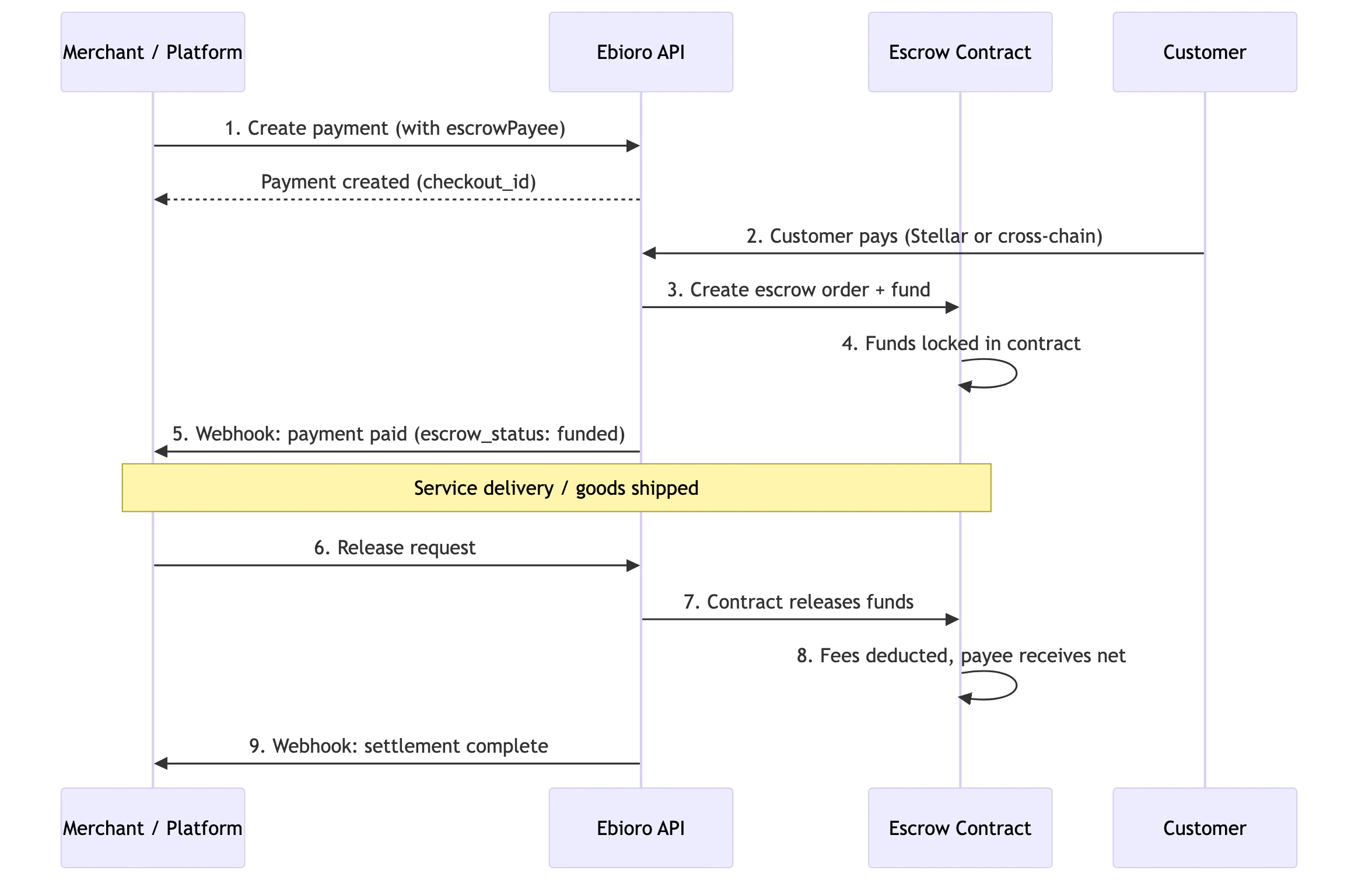
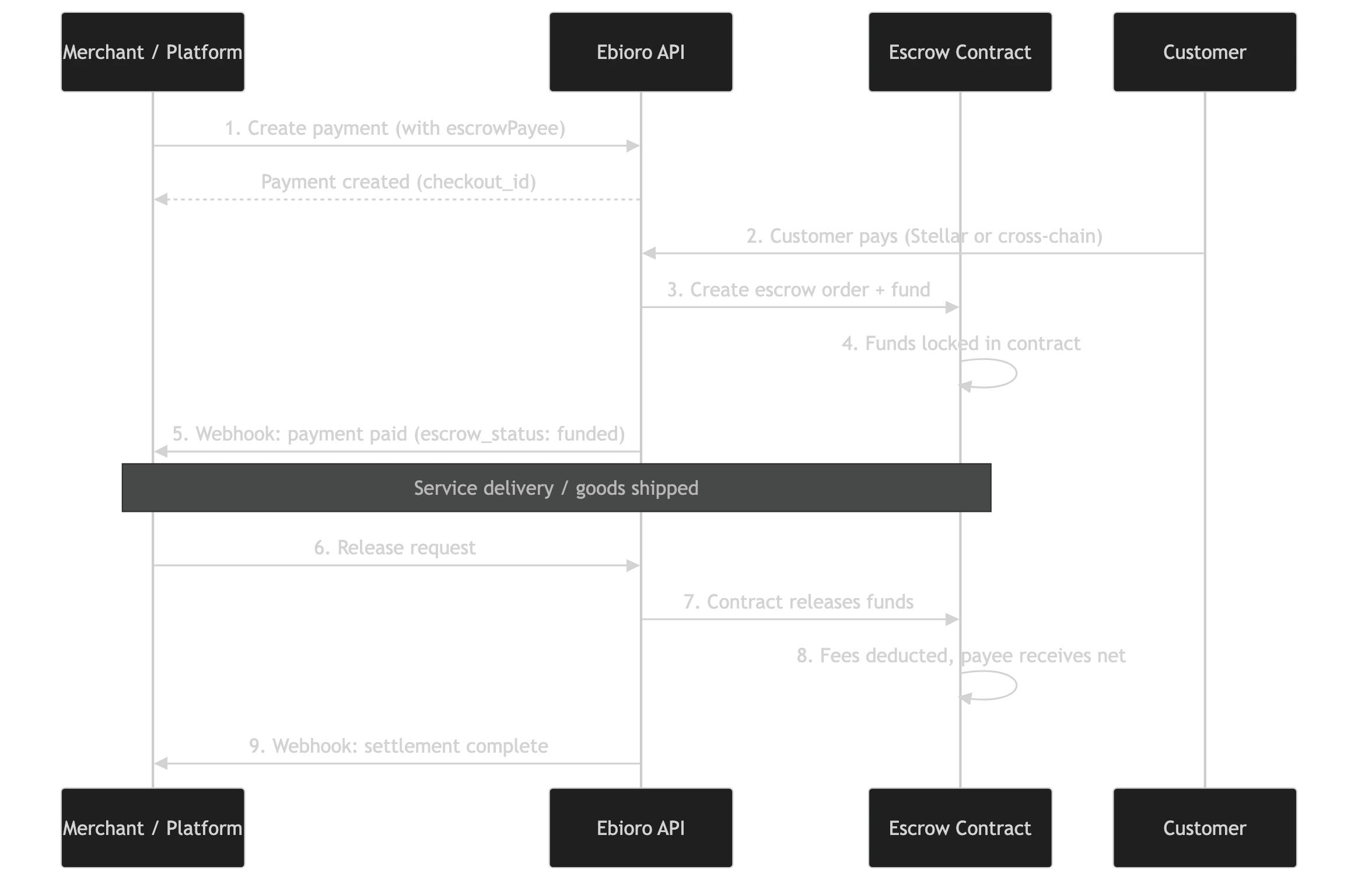
Roles
Every escrow payment involves up to four roles. Understanding who is who is essential to choosing the right configuration.Payer (Customer / Sender)
The person or entity that sends the money. This is the customer buying a product, the rider paying for a trip, or the sender in a remittance. The payer’s funds are locked in the escrow contract until the release conditions are met. Examples: a customer on an e-commerce site, a rider in a ride-hailing app, a sender transferring money abroad.Payee (Recipient / Service Provider)
The person or entity that receives the money once funds are released. This is the party that delivers the product, provides the service, or pays out the remittance locally. Examples: a driver (Uber), a host (Airbnb), a freelancer (Upwork), a licensed remittance operator, a merchant at a physical store.Platform Owner
The entity that owns the escrow instance and may have the authority to release or refund payments depending on the release policy. The platform owner is set when the escrow contract is deployed.- In a marketplace, the platform owner is the marketplace company (e.g., the ride-hailing company or the freelance platform).
- In a remittance flow, the platform owner is typically Ebioro itself.
- In a POS integration, the platform owner could be the IT provider or Ebioro.
Ebioro Operator
Ebioro’s system address, which acts as the payment infrastructure layer. In certain release policies (operator_or_payee, operator_after_timeout), the Ebioro operator has the authority to release funds from the escrow contract.
Quick Reference
The payee and the platform owner can be the same entity. For example, in a remittance flow the licensed operator is both the payee (receives the funds) and the merchant. In a marketplace, the driver is the payee but the marketplace company is the platform owner.
Escrow vs Direct Settlement
Release Policies
Each escrow merchant is configured with a release policy that determines who can release funds and when. See Roles above for who each actor is.Creating an Escrow Payment
Escrow payments are created through the samePOST /payments endpoint. No extra steps are needed — you can optionally include escrowPayee and/or escrowPlatformFee:
When to use
escrowPayee:
- Ride-hailing / delivery (Uber): Set it to the driver’s or courier’s address — it changes per order.
- Rental platforms (Airbnb): Set it to the host’s or property owner’s address.
- Freelance / services marketplaces (Upwork): Set it to the freelancer’s or service provider’s address.
- Remittances / POS: Don’t set it — the merchant is the payee, so the default is correct.
escrowPlatformFee:
- When the platform fee varies per order (e.g., different commission rates per service type or customer).
- If not set, the merchant’s default platform fee is used.
Both
escrowPayee and escrowPlatformFee are only applicable for merchants with settlement_mode = escrow. For direct settlement merchants, these fields are ignored.Payment Lifecycle (Escrow)
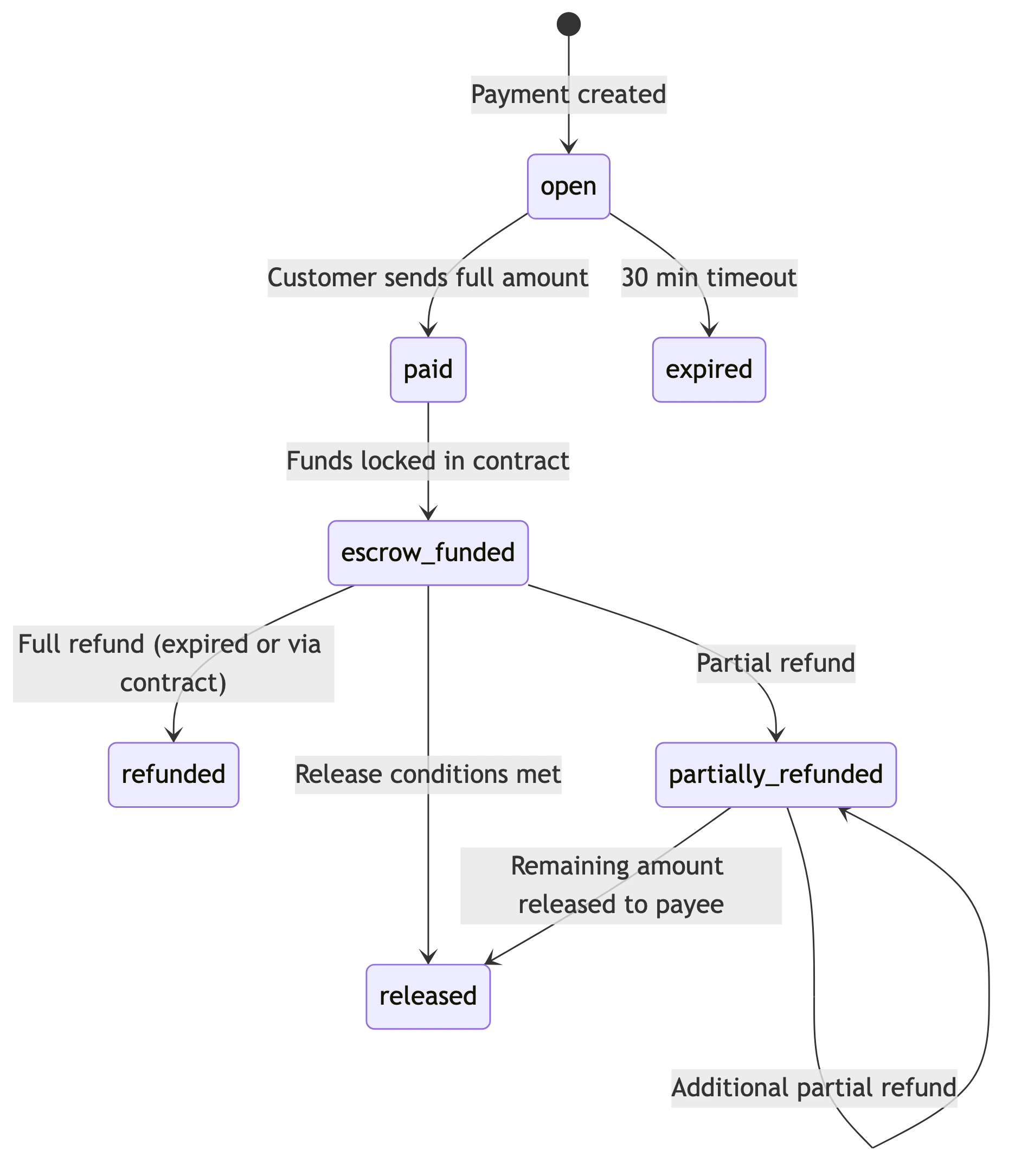
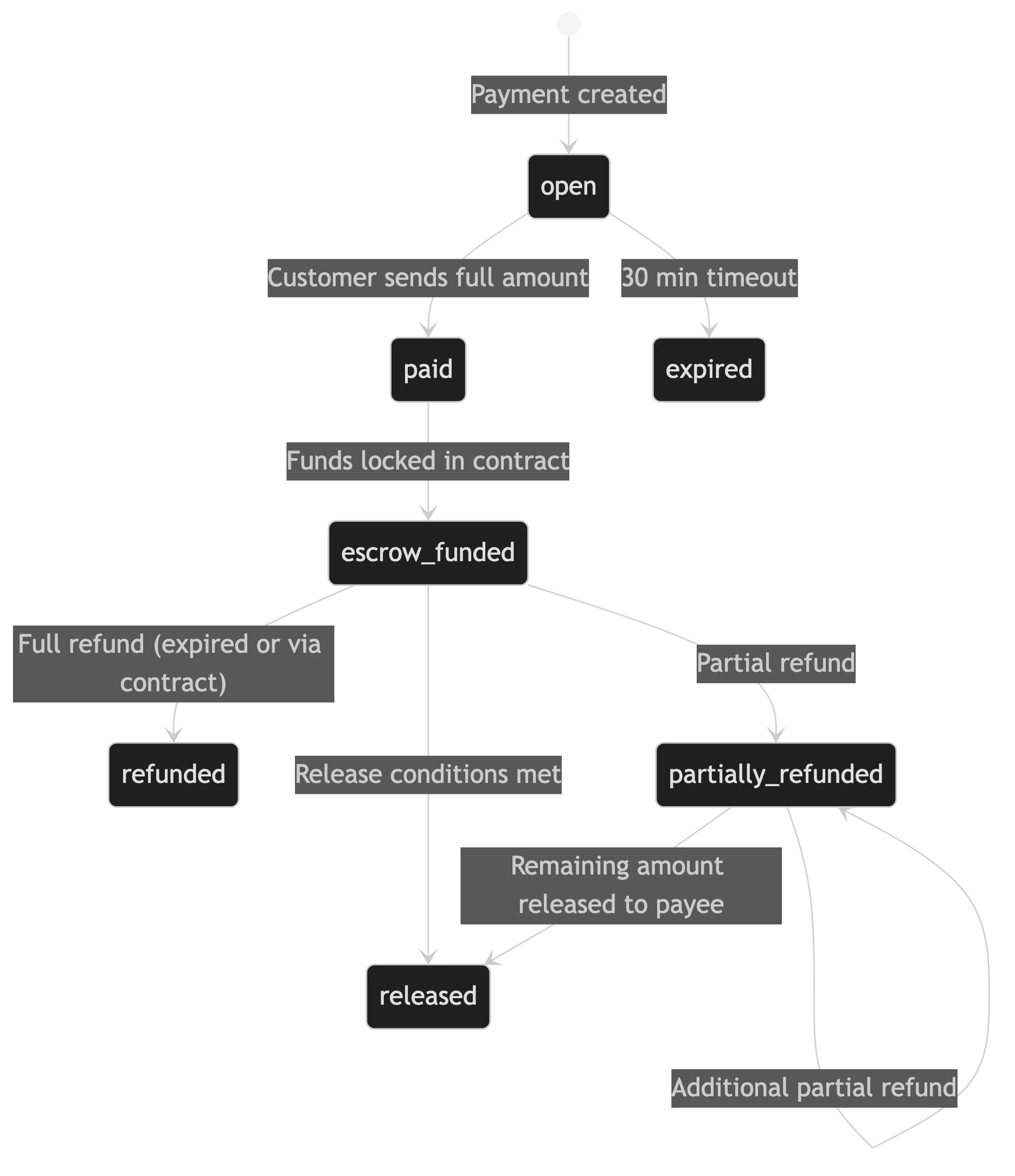
Escrow-Specific Statuses
Fee Structure
There are two types of fees, deducted at different stages:- Ebioro processing fee — deducted before funds enter the escrow contract. The amount locked in escrow is already net of this fee. Note that escrow processing fees differ from direct settlement fees.
- Platform fee — deducted at release time from the escrowed amount. This is the marketplace or partner commission, configured per merchant.
- Customer pays: $100 USDC
- Ebioro processing fee: deducted before escrow
- Amount locked in escrow: net of Ebioro fee
- Platform fee: deducted at release
- Payee receives: net amount after both fees
Use Cases
Marketplace / Gig Economy
A ride-hailing or delivery platform where customers pay upfront and drivers receive payment after service completion.- Release policy:
platform_only - Flow: Customer pays → funds locked → service delivered → platform confirms → driver paid
POS / E-commerce
An IT provider integrates Ebioro as a payment method for physical stores or online shops.- Release policy:
platform_onlyoroperator_or_payee - Flow: Customer pays at checkout → funds locked → merchant confirms fulfillment → funds released
Remittance Delivery via Licensed Operator
A sender initiates a cross-border payment. A licensed local operator delivers funds (bank deposit, cash payout) to the recipient. Ebioro validates delivery before releasing funds.- Release policy:
platform_only - Flow: Sender pays → funds locked → operator delivers locally → Ebioro validates delivery → operator paid
Cash Off-Ramp
A licensed cash operator allows users to convert crypto to physical cash at a physical location.- Release policy:
operator_after_timeout - Flow: User pays → funds locked → cash handed over → timeout window → operator releases after timeout
Webhooks
Escrow payments send the same webhook events as regular payments, with additional escrow fields:Coming Soon
Escrow Release Endpoint
Escrow-Aware Refunds
refund_expired and partial_refund) for escrowed payments.
Setup
Escrow settlement is enabled per merchant. Contact [email protected] to configure:settlement_mode: escrow- Release policy for your use case
- Platform fee structure
- Escrow contract deployment